


In the 10 months that have passed, she has not changed her tune. She resigned because she recognized the cost that the frivolous ethics complaints were having on her state, and she saw how much of her staff's time and her own time were forced to deal with those issues. She recognized how much money these unsubstantiated complaints cost her family. She was able to effectively fulfill her role as Governor, so she passed the reins onto someone who didn't have to be concerned that if he sneezed in the Lower 48, an ethics complaint would be thrown at him.Every one - all 15 of the ethics complaints have been dismissed. We've won! But it hasn't been cheap - the State has wasted THOUSANDS of hours of YOUR time and shelled out some two million of YOUR dollars to respond to "opposition research" - that's money NOT going to fund teachers or troopers - or safer roads. And this political absurdity, the "politics of personal destruction" ... Todd and I are looking at more than half a million dollars in legal bills in order to set the record straight. And what about the people who offer up these silly accusations? It doesn't cost them a dime so they're not going to stop draining public resources - spending other peoples' money in their game.
It's pretty insane - my staff and I spend most of our day dealing with THIS instead of progressing our state now. I know I promised no more "politics as usual," but THIS isn't what anyone had in mind for ALASKA.
....
My choice is to take a stand and effect change - not hit our heads against the wall and watch valuable state time and money, millions of your dollars, go down the drain in this new environment. Rather, we know we can effect positive change outside government at this moment in time, on another scale, and actually make a difference for our priorities - and so we will, for Alaskans and for Americans.
 ****Our article, as published on BigGovernment.com on April 4, 2010.****
As the Central Illinois 912 Project has addressed previously on BigGovernment.com, Shorebank is a community bank based out of Chicago that is engaged in microfinancing – a hybrid of capitalism and social justice. They have been supported and promoted by individuals like Van Jones, President Obama, President Clinton, and Secretary Clinton. They have also become heavily involved in the financing of green projects (see here and here).
Interestingly, Shorebank is currently seeking support from a few large banks –all of which have received federal bailout money from the Toxic Asset Relief Program (TARP) and are Shorebank stockholders. These banks include Citigroup, Bank of America, and Chase. Citigroup initially received $25 billion in taxpayer money (plus another $20 billion soon after), and Bank of America initially received $15 billion (plus another $20 billion after that). Neither of these banks has completely paid back their TARP loan. Chase also received $25 billion in bailout funds, but repaid its loan in December of 2009. So rather than seeking a bailout from a state that has a $13 billion budget deficit, Shorebank is seeking to be bailed out by banks that have already been bailed out by federal taxpayers – which is, in essence, an indirect, federally-funded bailout.
Interestingly, Shorebank is currently seeking support from a few large banks –all of which have received federal bailout money from the Toxic Asset Relief Program (TARP) and are Shorebank stockholders. These banks include Citigroup, Bank of America, and Chase. Citigroup initially received $25 billion in taxpayer money (plus another $20 billion soon after), and Bank of America initially received $25 billion (plus another $20 billion after that). Neither of these banks has completely paid back their TARP loan. Chase also received $25 billion in bailout funds, but repaid its loan in December of 2009. So rather than seeking a bailout from a state that has a $13 billion budget deficit, Shorebank is seeking to be bailed out by banks that have already been bailed out by federal taxpayers – which is, in essence, an indirect, federally-funded bailout.
However, it may also be surmised that Shorebank may instead be the direct recipient of bailout money. The Department of Treasury has suggested that it may use TARP funds to assist “Community Development Financial Institutions” (CDFIs). The Treasury defines a Community Development Financial Institution as
… a financial institution that works in markets that are underserved by traditional financial institutions. CDFIs are certified by the Department of the Treasury’s CDFI Fund, which was created for the purpose of promoting economic revitalization and community development in low-income communities.
In February, Secretary Geithner proposed “enhancement” to TARP funds specifically aimed at community development banks that would allow them to receive capital investment funds at a 2% rate (compared to the standard 5% rate) and to receive federal TARP funds that would be matched to funding received from private institutions. Chicago Congresswoman Jan Schakowsky wants ShoreBank to be eligible for such funding and has even suggested that such funding would be equivalent to a jobs program for the area. “Plain and simple, this is a jobs program,” she says. “The funds from this program will go directly to the people and communities that need it most which will expedite hiring and rebuild a vibrant economy”.
Shorebank has received free consulting assistance from Promontory Financial, which is headed by a former director of Shorebank, Eugene Ludwig. Ludwig also helped found CapGen, an entity that invests primarily in community banks. Ludwig was formerly Comptroller of the Currency during the Clinton administration. This would not be the first time that Promontory Financial assisted in raising capital for Shorebank. In 2007, Promontory was a key player in a transaction where TIAA-CREF, a real estate developer and financier, deposited $22 million with Shorebank. TIAA-CREF also supported Shorebank in 2009 with the same type of funding via consultants at Promontory. Receiving funding by similar means now would likely help Shorebank raise private funding that would be matched by federal TARP dollars.
What might be the issue with Shorebank? Could they be the next in the line of banks about to fold, or are they the next in line to receive bailout money (either indirectly or directly)? Will they do the unprecedented and become one of the first entities to be bailed out by a state that itself has a $13 billion deficit? With its promotion of green development and new carbon credit distribution, could Shorebank become one of the first banks to be deemed too “green” to fail?
Crossposted here.

This past week, the Environmental Protection Agency (EPA) announced a series of new environmental standards. These standards include more stringent Corporate Average Fuel Economy Corporate Average Fuel Economy (CAFE) standards and structured enforcement of Clean Air Act permits for facilities that produce greenhouse gases beginning in 2011.
The EPA was founded in 1970 during the Nixon administration with the following mission:
The establishment and enforcement of environmental protection standards consistent with national environmental goals… The conduct of research on the adverse effects of pollution and on methods and equipment for controlling it; the gathering of information on pollution; and the use of this information in strengthening environmental protection programs and recommending policy changes… assisting others, through grants, technical assistance and other means, in arresting pollution of the environment… assisting the Council on Environmental Quality in developing and recommending to the President new policies for the protection of the environment. (emphasis mine).
As the Central Illinois 912 Project has addressed previously, the EPA was granted the power to declare carbon dioxide a pollutant and thus it is able to be regulated by the EPA via a 2007 Supreme Court case , and this ruling is being challenged.
CAFE standards are regulations that car manufacturers must meet regarding the average fuel efficiency of the vehicles they sell, not the fuel efficiency of the cars they produce. For example, if gas prices drop, and people thus begin to purchase cars with lower fuel efficiency, the CAFE level for that company decreases. This could result in a company being penalized, even if they made fuel efficient cars that the consumers simply did not want to purchase. The EPA’s creation of CAFE standards is essentially a regulation on industry that falls in line with the mission of the EPA: “establishment and enforcement of environmental protection standards.” However, since the EPA is an agency whose role is administered under the executive branch, how can it constitutionally make and enforce regulations, a role given to the Legislative Branch?
The same can be said of the plans to enforce permits for the emission of greenhouse gases (e.g., carbon dioxide) from stationary facilities, such as manufacturing plants, via the Clean Air Act. The EPA states:
Today’s action determines that Clean Air Act construction and operating permit requirements for the largest emitting facilities will begin when the first national rule controlling GHGs takes effect. If finalized as proposed, the rule limiting GHG emissions for cars and light trucks would trigger these requirements in January 2011 – the earliest model year 2012 vehicles meeting the standards can be sold in the United States. The agency expects to issue final vehicle GHG standards shortly.
“The Clean Air Act” includes several pieces of legislation passed over the last few decades that define the EPA’s role in regulating air and the ozone. Fifteen states have sued the EPA from making such regulations until further study can be done to re-affirm that such emissions can be hazardous to one’s health, but they are not challenging on the grounds of Constitutionality. Again, why is the EPA regulating or enforcing regulations that should be formulated by an elected Congress, not an unelected “independent agency”?
Is it not again twisting the branches of government if an agency of the executive branch is legislating production and carbon emissions? Is Congress not appropriately providing the proper checks and balances if it allows unelected bureaucrats to do their elected job of legislating?
Crossposted here.
 I didn't have time to make a sign, so I thought this would suffice!

 Former gubernatorial candidate, Adam Andrezjewski, calling for a forensic audit of state spending. During one the debates earlier this year, in response to the question, "who is your political role model, Adam said, "I'd rather be a Sarah Palin than an Arnold Schwarzenegger".
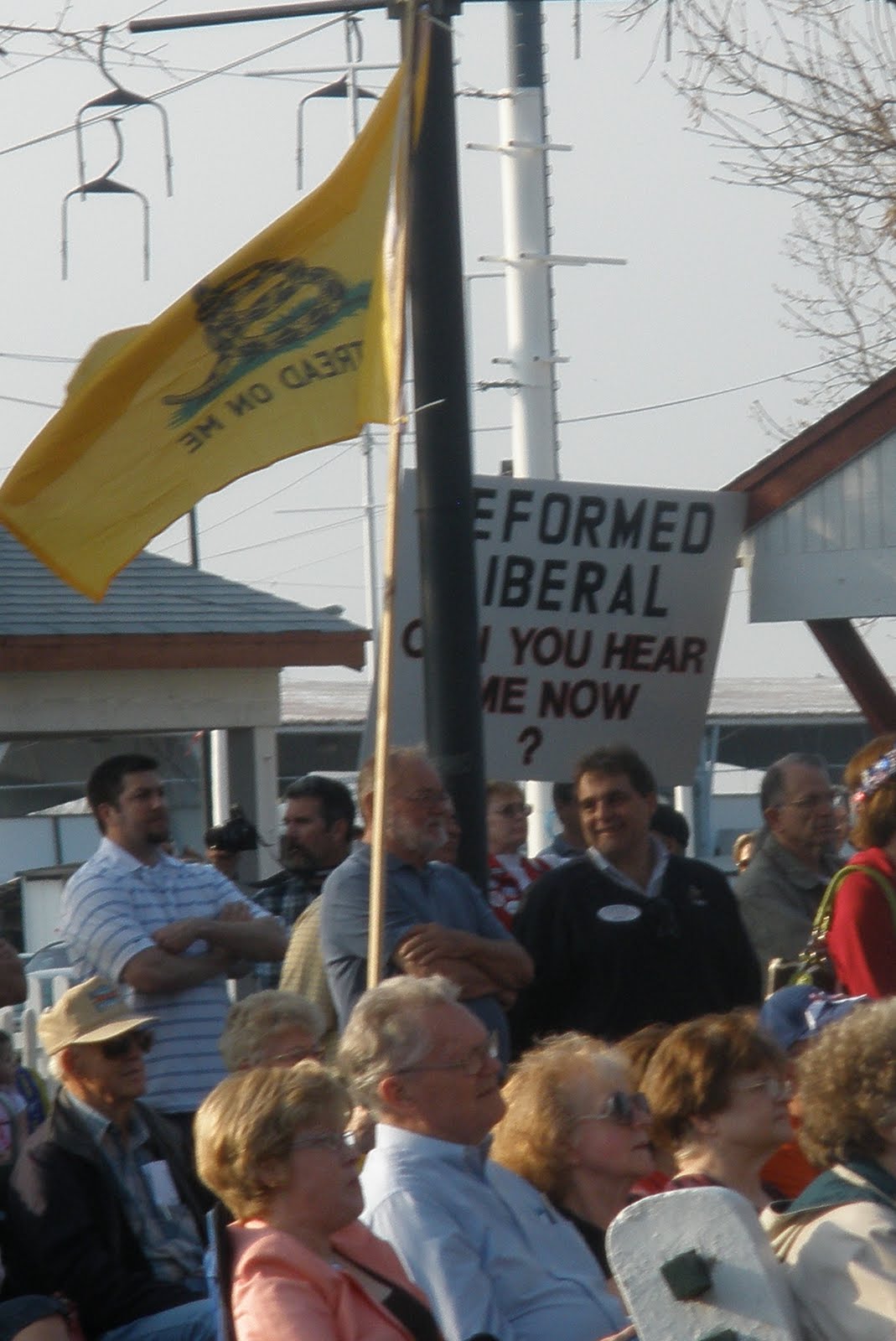

 Why this really matters.
 It wouldn't be an event in Springfield,Illinois
 All Tea Party or Sarah-related buttons.
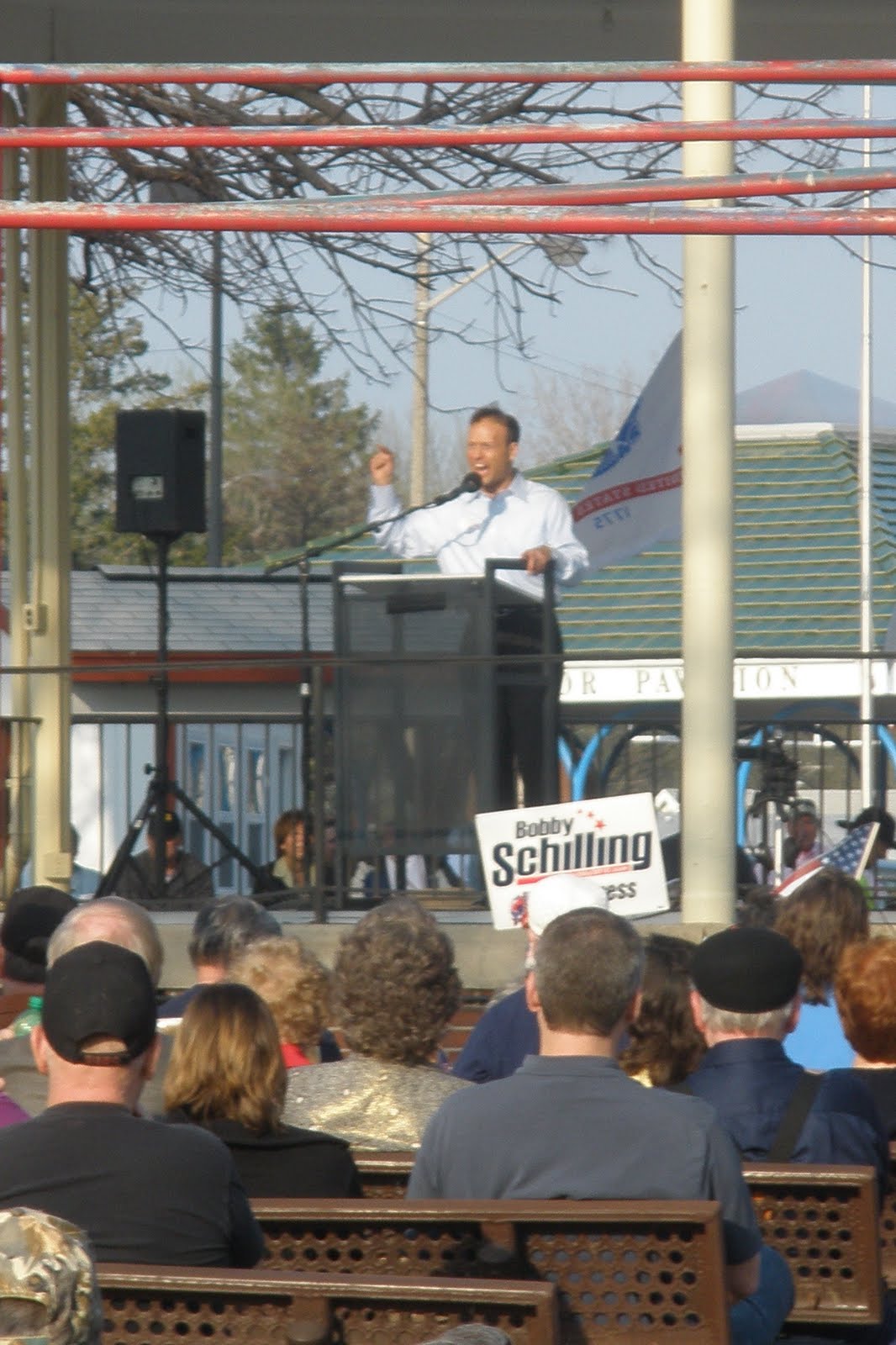
 Bobby Schilling, father of 10 kids and
